Malachite can be damaged by sun exposure: Its copper-based composition may cause fading, surface dullness, and structural weakening over time. If you remember one thing, know that this vibrant green stone thrives away from direct sunlight to maintain its signature banded beauty.
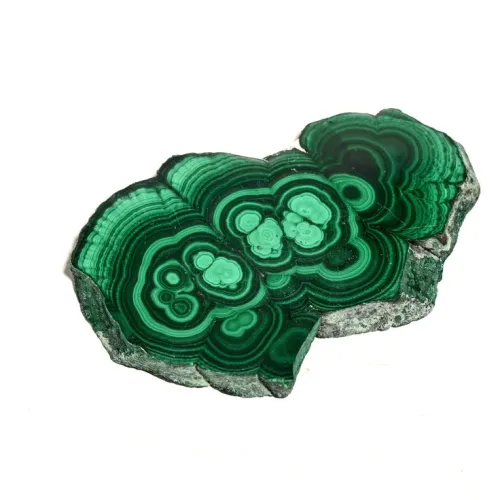
Imagine walking into a mineral shop, mesmerized by that deep green malachite bowl glowing under gallery lights. Later, when showing treasure to friends online, you spot conflicting advice: "Natural stone loves sunshine!" vs. "NEVER leave it outdoors!" Sound familiar? This haze of crystal-shop chatter and quick-fix TikTok theories often leaves collectors confused about sunlight safety. Whether it's the jewelry we wear daily or decorative pieces on sunny shelves, we'll cut through the noise by matching common claims about malachite against observable mineral traits. Together, we'll sort fleeting assumptions from testable facts—like how banding patterns react to UV rays—so you can confidently enjoy your pieces without guesswork drama.
Picture setting a raw malachite slice on your sun-drenched patio table for a garden party centerpiece. Guests comment how its forest greens glow "even brighter" outdoors, reinforcing that popular Instagram trend showing crystals basking beachside. This intuition stems from how sunlight enhances some minerals—think quartz sparkle or amber warmth—but malachite shares no such kinship. The myth persists partly because early fading appears subtle: during that single afternoon party, you might only notice slight dullness, mistaking it for temporary glare rather than cumulative photochemical damage starting at atomic levels.
In reality, malachite absorbs UV radiation like solar-sponge due to its elemental backbone. Technically speaking, copper carbonate minerals undergo photoreduction reactions when photons destabilize copper-oxygen bonds. This may manifest as color fading over weeks or months, depending on exposure duration and intensity. More critically, the stone isn't just reacting to light but the accompanying heat buildup. Gentle morning rays cause less harm than high-noon summer sun which can exacerbate dehydration internally.
When choosing malachite display spots at home, treat sunlight angles like splash zones near a pool. That eastern kitchen window everyone loves? Better for morning coffee rituals than mineral safekeeping. Instead, place pieces where indirect ambient light reveals banding patterns—think hallway niches, bookshelves away from windows, or dining tables beneath pendant lamps. For outdoor events like weddings where malachite cake stands or décor seem perfect, schedule short appearances during softer lighting hours and rotate pieces every 30 minutes.
A friend once gifted you malachite earrings with copper backings, saying: "See? The metal connects it to sunlight energy!"—a poetic notion fueling beliefs that same-element pairings foster resilience. We inherit these romanticized ideas from lore where malachite "guarded miners" in sunlit mountains. Yet this connection overlooks how pure copper develops protective patina whereas its carbonate form behaves differently internally.
The clearer way to see it involves atomic vulnerabilities: malachite contains about 57% copper in its [Cu2CO3(OH)2] structure. When UV photons strike, they excite electrons in copper ions which subsequently release energy by breaking hydroxyl bonds. Unlike opaque metals that reflect radiation, malachite’s semitranslucent layers enable deeper photon penetration causing cumulative harm. Additionally, its slight porosity tends to accelerate moisture loss under solar heat, leaving microscopic channels where destabilized elements further degrade cohesion.
Before buying malachite jewelry or ornaments, ask sellers two things: "Was this stabilized post-mining?" and "What’s the Mohs hardness?" Avoid pieces labeled "natural finish" for patio placements, as resin treatments can protect pores better. When comparing specimens, hold them near non-UV lamps—denser malachite with tighter banding tends to withstand minor sun slips better than highly porous samples.
Visualize inheriting your grandmother’s beloved malachite brooch. Beside newer rings, its once-sharp bands now resemble watery watercolors—what relatives call "vintage charm" might actually be sun-related color migration. Such slow transformations frequently go misinterpreted because early-stage fading mimics dust accumulation or temporary cloudiness after cleaning. People expect damage to announce itself dramatically like cracks or chips, not this subtle washing-away of vibrancy where turquoise undertones disappear first.
Objectively speaking, malachite’s hues derive from copper-electron interactions within specific crystalline arrangements. Prolonged solar exposure may induce electron transfers that mute colour centers, resulting in "banding blur." Simultaneously, surface moisture evaporation can create chalky micro-crystals called efflorescence—which scattering light differently gives that dusty appearance. Interestingly, specimens with alternating light/dark bands exhibit uneven fading as darker zones retain heat longer, explaining patchy degradation patterns.
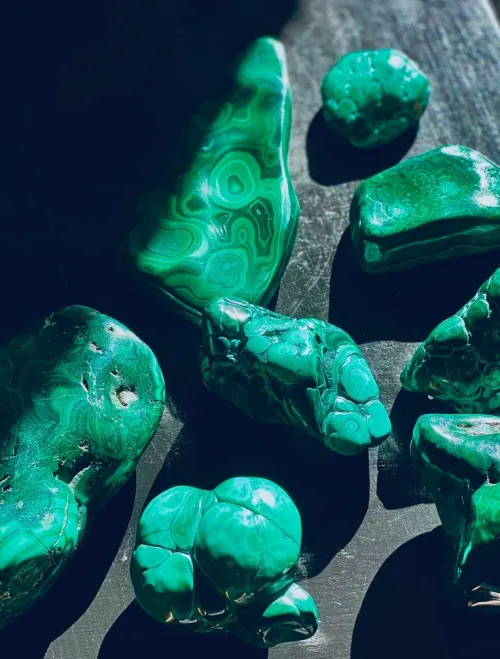
Develop an inspection routine each time you handle malachite: rotate it under soft white LEDs (not yellow bulbs) hunting for pale zones along curved surfaces—these receive concentrated sunlight. Keep photo documentation showing original colors; quarterly checks against these references reveal subtle changes unnoticed day-to-day. If placing malachite near light sources is unavoidable, consider museum-grade UV-filtering acrylic cases or rotating displays among shaded spots.
Overheard at a gem show: "But malachite forms near hydrothermal vents! Surely light won’t phase it." This assumption links natural environments to human settings incorrectly—like assuming desert cacti can thrive in rainforests. While malachite indeed crystallizes in sunless underground cavities and oxidizing copper deposits, these geological processes involve stable mineral-rich fluids, not atmospheric exposure.
In truth, malachite develops gradually through chemically saturated groundwater trickling across ore layers—an environment buffered from solar radiation and rapid temperature swings. Modern specimens extracted from Arizona mines or Congo deposits evolved under consistent 53-59°F groundwater flows with zero UV exposure. Exposing them suddenly to living-room window scenarios shocks their structure differently than nature’s slow reveal during mining excavations. Crucially, dehydration becomes more aggressive above ground: museum studies show surface dehydration rates triple when humidity drops below 40% versus their native damp caves.
When purchasing malachite, politely challenge vendor claims like "sun-hardened by nature" by asking about origin conditions. Specimens from deep underground Zambian copper belts typically show greater structural integrity than surface-near Russian deposits. Display them near houseplants or humidity trays maintaining 45-55% ambient moisture to mimic native environments. For travelers wanting souvenir malachite, request pieces stored inside cabinets rather than outdoor market stands.
Consider Janet, who wears her malachite pendant daily—through grocery runs under skylights, coffee shop window seats, and evening walks. "It feels invincible!" she laughs, unaware how brief but repeated exposures accumulate photon impact. Such fragmented routines create illusions of safety because individual sessions cause imperceptible harm; few connect their 20-minute commutes with slow colour changes observed months later.
Practically speaking, malachite jewelry experiences "micro-exposures" from incidental activities: driving with sunlight glancing off dashboard gems or sitting near office windows. While copper settings offer zero protection, pendant styles dangling outside clothing bear more UV impact than rings covered by sleeves. Furthermore, temperature shocks matter—picture stepping from air-conditioned stores into summer heat causing minute expansions that stress already dehydrated layers.
Adopt protective habits: slip necklaces inside collars during midday travels or choose pendant shapes less prone to outward-swinging motions that maximize light contact. If collecting decorative malachite globes or bookends, limit rotations through sunny rooms to winter months when UV index drops below 3. Simple awareness shifts help: pause upon opening curtains each morning to position at-risk pieces behind ceramic vases or within glass-door cabinets.
During workshop consultations, someone insists: "I’ll just polish yearly so sun damage seems to vanish!"—a risky approach since abrasives remove surface layers hiding underlying brittleness caused by solar dehydration. People fixate on visible consequences but overlook invisible vulnerabilities created concurrently. Temperature remains the stealth destroyer: rapid solar heating followed by quick cooling generates micro-fissures which magnify breakage risks during polishing, setting repairs, or accidental bumps.
Technically, prolonged sun exposure accelerates multiple vulnerabilities simultaneously: beyond color loss, structural water loss in malachite may lead to increased susceptibility to fracture with hardness potentially dropping up to 1 Mohs point under light stress. Crucially, some cleaning chemicals react unpredictably with photo-damaged surfaces—alcohol-based sprays may accelerate brittleness or induce efflorescence after sunlight compromises the mineral matrix.
Establish "light audits" for your collection: use phone apps to measure UV indexes near display zones monthly. Areas exceeding 25µW/cm² warrant relocation efforts. When storing malachite, wrap pieces in anti-tarnish cloth inside wood boxes—never plastic bins trapping heat. For deep cleaning, skip ultrasonic baths that may shake weakened structures; instead, opt for microfiber cloths lightly dampened with pH-neutral water. Remember: the banding patterns that make malachite enchanting require proactive shading more than reactive repairs.
If malachite were a houseplant, sunlight would be that temperamental variable needing constant calibration. The good news? Mindful collectors preserve deep greens for generations. Start by prioritizing shade logic: evaluate light exposure by room usage patterns rather than just window placements. Understand that brief-but-repeated UV exposure accumulates silently—like those jewelry moments during daily commutes or decorative pieces moved temporarily for guests. Finally, engage your observational superpower: periodically examine stones under consistent lighting for early warning signs of color migration from emerald to pale sage. Next time you admire a malachite piece—whether in stores or inherited collections—notice how bands catch light, then consciously ask: "Where’s the safest stage to showcase this performance?" Your choices now preserve vibrancy longer than any polishing ritual ever can.
Q: Can I display malachite under indoor lamps?
A: Most standard LED or incandescent bulbs generate negligible UV compared to sunlight—position pieces at least 5 feet away from intense gallery spotlights that may generate localized heat waves. Use low-temperature bulbs below 40W where proximity is unavoidable.
Q: If my malachite already has sun damage, can restoration help?
A: Surface polishing by gemologists may improve superficial appearance, but underlying dehydration effects tend to be permanent. Prevention works better; store damaged pieces in stable dark environments to halt further degradation. Avoid commercial "re-greening" solutions that employ dyes.
Q: Does malachite’s size affect sun sensitivity?
A: While thickness influences damage progression rates, no safe threshold exists. Thin cabochons may show color loss faster due to deeper light penetration relative to volume, whereas large carvings experience uneven fading across surface contours receiving varied light angles.


$
